Weddings and Receptions
Buffet or Plated Dinner
Weigh buffet lines against plated service for cost, timing, guest choice and dietary needs, and learn how to read a banquet menu plan.
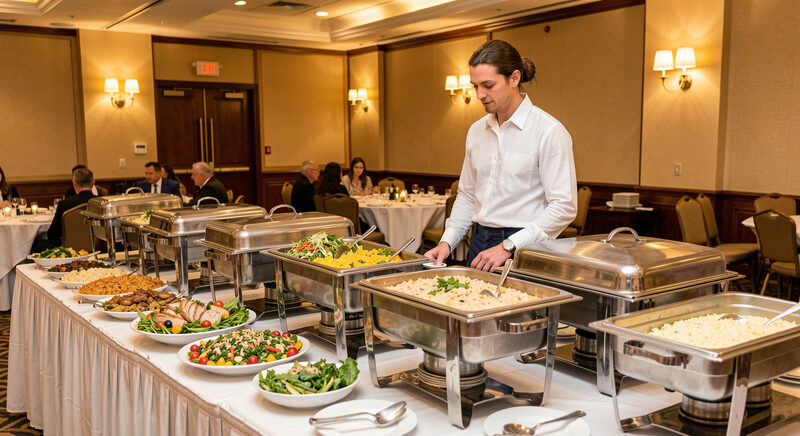
The choice between a buffet and plated service is one of the first real decisions of a banquet, and it reaches further than the menu. It changes the number of servers, the length of the meal, the layout of the room and the cost per guest. It also changes how the evening feels, because food served in a line and food served to a seat are two different kinds of hospitality.
This guide compares the two honestly, explains how a banquet menu is usually organised, and covers the dietary questions that decide whether a menu actually works for the guest list.
How a buffet works
A buffet sets the food out on a line of chafing dishes and lets guests serve themselves. It usually costs less per guest than plated service, because it needs fewer servers and less kitchen time. It gives guests control over what and how much they eat, which matters when the guest list spans several generations and a range of tastes. And it lets a hall feed a large room without the timing pressure of a plated kitchen.
The trade-offs are real. A single buffet line for two hundred guests can take a long time to clear, and the first guests may be finishing before the last are served. The food must hold at temperature, which limits what can be served. And a buffet needs a wide aisle that does not cross the dance floor, which changes the room layout. A double-sided buffet, or two stations serving the same menu, fixes the queue and is worth asking about for a large event.
How plated service works
Plated service brings a set number of courses to each seat. It feels more formal, it controls the pace of the meal, and it avoids the queue entirely. The cost is higher, because it needs more servers and a kitchen that can plate many dishes at once. It also requires the guest to choose a main course in advance, which means a reply card or an online form, and it fixes the menu in a way a buffet does not.
Plated service suits a smaller, more formal dinner, or a room where the layout leaves no good space for a buffet line. For a large, informal, family-heavy reception, a buffet is often the better fit even when the budget would allow either.
The hybrid that solves a large room
Many halls offer a middle path: a buffet for the main courses with a plated salad or soup, or a served first course followed by a buffet. This keeps the formal opening and the informal main, and it spreads the work between the kitchen and the line. Ask the venue whether it offers a hybrid, because it is often the best answer for a room of a hundred and fifty to two hundred guests.
How a banquet menu is organised
A banquet menu is usually built from a small number of choices at each course rather than a long list. A typical structure offers one or two salads, two or three mains, a starch and a vegetable, bread, and a dessert or a cake. A buffet may offer more mains because the guest takes a little of several. A plated menu offers fewer because each plate is a decision made in advance.
Ask to see the menu in writing and ask how many guests must choose each main. A venue that needs exact counts will want the numbers a week or two ahead, and it will usually name a deadline. Ask, too, whether the menu can be adjusted for the season, because a heavy winter menu reads oddly in July.
Dietary needs and the guest who eats differently
Every guest list has someone who does not eat what everyone else is eating: a vegetarian, a guest who avoids gluten, a child who wants something simple, or someone with a serious allergy. A buffet handles most of this naturally, because the guest chooses. A plated menu has to plan for it in advance, which means the reply card must ask.
Ask the venue how it handles allergies, and ask whether the kitchen prepares those plates separately. For a serious allergy this is not a courtesy but a safety question, and a venue that takes it seriously will have a clear answer. If the hall brings in a caterer, ask the same questions of the caterer and confirm who is responsible for the special plates.
The cost difference, in plain terms
A buffet is usually the cheaper option per guest, but the gap narrows once the extras are counted. A buffet may need more chafing dishes and more food to allow for seconds, and it may need an extra station for a large room. Plated service costs more in staff but wastes less food. The honest comparison is the cost per guest for each option, side by side, with the same dessert and the same bar. The method for building that comparison is in what a banquet hall costs.
Reading a package plan
Many halls sell a package that bundles the room, the meal, the soft drinks and the staff. Read the package line by line and ask what is not included: the bar, the cake, the linens in a colour you want, an extra hour, a second bar, the coffee station. A package that looks complete often has one or two gaps, and the gaps are where the final bill grows. Ask for the package and a list of the exclusions on the same page.
Choosing, and moving on
Choose the service that fits the room and the guest list rather than the one that sounds more impressive. A large, lively West Side reception with a good buffet and a short line will feel better than a plated dinner served slowly to a crowded room. Once the menu is set, the next decisions are the bar and the schedule, covered in bar service and Ohio liquor rules and a wedding reception timeline. Couples still choosing a venue can begin with choosing a banquet hall.