Planning and Logistics
Planning and Logistics
The parts guests never see: bar service and Ohio liquor rules, sound and a dance floor, parking and access, deposits and contracts.

The parts of an event that guests never see are the parts that decide whether it feels easy. The bar, the sound, the parking, the deposits and the contracts are unglamorous, and they are exactly where a well-planned evening separates itself from a stressful one. None of them is difficult on its own. The trouble comes when they are left until the last week.
This section covers the logistics that sit behind every banquet, from the rules that govern alcohol in Ohio to the practical questions of arrival, access and paperwork.
The bar, and the rules that surround it
Alcohol is the most regulated part of any banquet, and the rules vary by state and by the type of event. In Ohio, as in most states, there are requirements about who may serve alcohol, how it may be sold, and what a private event may and may not do. A hall that holds its own licence can usually serve; a hall that does not may require a licensed caterer or a permit. Getting this wrong can spoil an evening that was otherwise perfect, so it belongs at the top of the list.
The options, from a cash bar to a limited bar to a fully open bar, and the way each is billed, are set out in bar service and Ohio liquor rules.
Sound, music and the dance floor
Music is what turns a room into a party, and it is also what can make conversation impossible. A live band needs a stage, height and power; a DJ needs a corner and an outlet. In a low room with hard walls, sound bounces and the far tables cannot hear each other, which is why the placement of the speakers matters as much as the volume. Ask the venue where other events have put the music and whether it has a sound system.
The dance floor itself is a piece of the layout, and it competes with the tables for space. The arithmetic is covered in capacity and room layout.
Parking, arrival and access
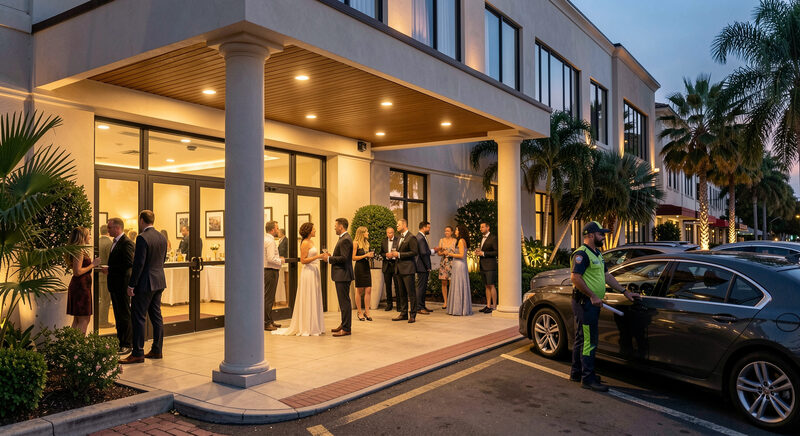
Guests arrive in a burst, all within a few minutes, and the first impression of the evening is formed in the parking lot. A hall with its own lot and a clear entrance spares everyone a stressful start. A drop-off point at the door helps older guests and anyone with limited mobility, and a step-free entrance is not a luxury for a family with a wheelchair. Winter adds snow and darkness to the equation, and a lit path from the lot to the door matters.
The full checklist, from drop-off to coat storage, is in parking, access and guest comfort.
Deposits, contracts and the paperwork
A booking is a contract, and the contract is what protects both sides when plans change. The deposit, the payment schedule, the cancellation terms, the minimum spend, the insurance requirements and the responsibility for damage are all in that document, and all of them are worth reading before signing. Ask for the contract in writing, keep a copy, and make sure the final guest count and the final menu are written into it or attached to it.
Keep a simple file for the event: the signed contract, the quotes, the menu, the timeline and the contact numbers for the venue and the vendors. When something needs to be checked on the day, one folder beats ten phone calls.
Staffing and the people who run the room
Ask who will be in the room during the event and how to reach them. A venue that assigns a manager to the evening gives the host someone to talk to when a small thing goes wrong, and small things always go wrong. Ask how many servers will be on the floor, and whether the number changes with the guest count or the menu. A buffet for two hundred guests served by too few staff is a long line; a plated dinner with too few servers is a cold meal.
Rentals and the things the hall does not own
Many halls provide tables, chairs and basic linens, and stop there. Everything else, from a dance floor to a stage to a projector to special glassware, may be a rental. Ask what is included, what can be rented from the venue, and what the client must bring. A rental delivered to the wrong address or on the wrong day is a common and avoidable problem, so confirm the delivery window and who will receive it.
A timeline for the planning itself
Logistics go smoothly when they are spread over months rather than crammed into the final fortnight. Roughly six months out, book the venue and settle the date and the guest count. Four months out, choose the caterer or the menu, decide the bar, and book the entertainment. Two months out, confirm the layout, the rentals and the parking plan, and read the contract again. One month out, send the final guest count, the seating plan and the timeline to the venue and the vendors. In the last week, confirm everything in writing and walk the room. A plan with dates on it stops the last week from becoming a scramble.
The week before, and the day of
In the last week, confirm the final guest count, the menu, the bar and the timeline in writing. Send the venue the seating plan. Confirm the arrival time for any vendors and where they should park and unload. Confirm who will open the room and at what hour, and who will lock it at the end. On the day, arrive early, walk the room, and check the small things: the lighting, the temperature, the sound, and the placement of the guest book and the gift table.
An event that has been planned through these logistics feels effortless to the guests, which is the whole point. Organisers starting from the beginning can open choosing a banquet hall, and those planning a specific kind of gathering will find it under banquets and gatherings or wedding receptions.

Planning and Logistics
Bar Service and Ohio Liquor Rules
Understand how alcohol is served at an Ohio event: licensed servers, cash and open bars, drink tickets, last call and keeping guests safe.
Cash, open or limited, and who may serve.
Planning and Logistics
Parking, Access and Guest Comfort
Plan parking, drop off, step free access, seating for older guests and a coat and gift area so arrival and departure stay calm.
First and last impressions, in the parking lot.