Banquets and Gatherings
Planning a Memorial Reception
Arrange a gathering after a service with a calm checklist: timing, room size, simple food, photos, parking and how to ask for help.
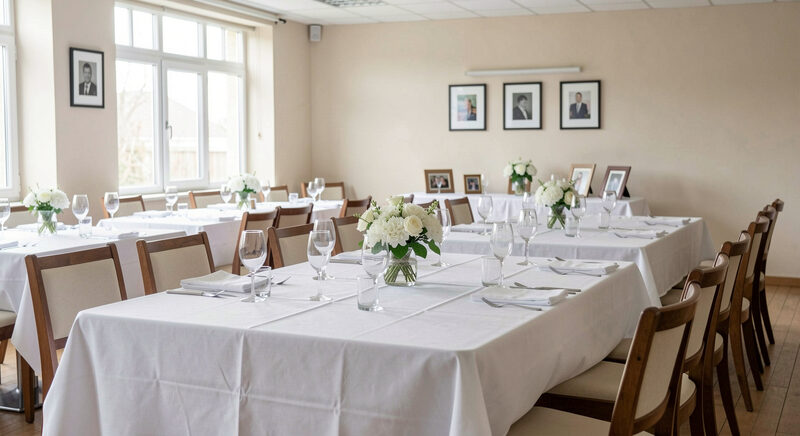
A reception after a funeral is planned in days, often while a family is still grieving, and it should be the easiest part of a hard week rather than the hardest. The purpose is simple: to give people a place to gather, to eat something, and to talk about the person who has died. Everything else is secondary, and much of what a wedding needs, a memorial reception does not.
This guide sets out a calm, short checklist: the timing, the room, the food, the small touches, and how to let other people help.
Start with the timing and the place
The service usually sets the clock. A reception after a morning funeral often runs from late morning into the early afternoon; after an afternoon service, it runs into the evening. Allow the guests twenty to thirty minutes to travel from the church or chapel to the hall, and have the room ready when the first of them arrives. A reception that opens as the family walks in feels like a welcome; one that opens half an hour later feels like a wait.
The hall should be close to the service, easy to find and easy to park at. A venue that is ten minutes away with its own lot will serve the day better than a beautiful room across town. The practical questions of parking and access are in parking, access and guest comfort.
The room: long tables and quiet corners
Long tables arranged in rows suit a memorial reception better than rounds. People sit beside one another and conversation flows along the table, and guests can join a table without disrupting it. Leave space for people to stand and move, because much of the gathering happens on the feet. A quiet corner for an older relative, and a table for photographs, a guest book and a few flowers, are worth more than any decoration.
Ask the hall to set the room simply. White or neutral linens, plain tableware, and soft lighting are enough. The layout arithmetic is the same as for any event and is covered in capacity and room layout.
The food: simple, warm and easy
The food should be easy to eat while standing and talking, and it should hold at temperature because guests arrive over a stretch of time rather than all at once. Sandwiches, soups, a simple hot dish, a salad, bread, coffee and tea are a complete and generous menu. A buffet is almost always the right choice, because it lets people eat when they are ready rather than at a fixed hour. Plated service, with its fixed courses, rarely fits the mood.
If the family has a favourite dish, serve it. Food that belonged to the person being remembered is a quiet and powerful thing. The buffet mechanics are in buffet or plated dinner, and the venue side of the cost is in what a banquet hall costs.
The bar, or no bar at all
Many memorial receptions serve no alcohol, or only wine and beer, and that is entirely a family's choice. A cash bar or a limited bar of beer, wine and soft drinks is common. What matters is that the choice is made in advance and that the hall is told, so the room is set correctly. If alcohol is served, the rules still apply, and they are set out in bar service and Ohio liquor rules.
The small touches that help
A framed photograph or two at the entrance. A guest book, so the family can read later who came. A stack of the order of service, for anyone who missed one. A table for cards and for anyone who wants to leave something. Soft background music, or none at all. These are small, and they do more than they cost.
Ask one person, not the family, to keep an eye on the room: to greet the first arrivals, to make sure the food is replenished, and to be the point of contact for the hall. A grieving family should not be managing a buffet line.
Letting people help
Friends and relatives almost always want to help, and the kindest thing is to let them, with a specific task. Someone to collect the flowers from the service and bring them to the hall. Someone to set out the photographs. Someone to make sure the coffee is hot. Someone to keep the guest book. A short list of named tasks turns goodwill into real support and takes the weight off the immediate family.
If the family belongs to a parish or a club, that community often organises the reception itself, which is both a practical help and a comfort. Accepting that help is not a burden on anyone.
A short checklist
Choose a hall close to the service with easy parking. Set the room with long tables, a photo table and a guest book. Serve simple, warm food as a buffet. Decide on the bar in advance. Name one person to run the room and a few to help. Keep the lighting soft and the music quiet. And leave the family free to do the only thing that matters that day: to be with the people who came.
Families planning a different kind of gathering will find the shape of it under banquets and gatherings, and anyone still choosing a hall can start with choosing a banquet hall.